

Know what happens next, from the first call to active deployment
The Complete Suriname Deployment Roadmap
A workforce deployment into Suriname is not one transaction.
It is a coordinated sequence involving employment structure, commercial setup, employee documentation, immigration, payroll, relocation, arrival, and ongoing compliance.
When these workstreams are managed separately, important dependencies can be missed. A contract may be ready while immigration documents are incomplete. Housing may be arranged before the arrival date is realistic. Payroll may be modeled without considering the employee’s rotation.
AZERRA brings the full process together through one accountable local team.
This roadmap explains what happens at every stage, what AZERRA manages, what the client and employee must provide, and where timing can change.
Every deployment is structured around the actual assignment
The route depends on factors including:
- Employee nationality
- Role and responsibilities
- Onshore or offshore scope
- Client and host-company structure
- Fixed or rotational schedule
- Intended start date
- Assignment duration
- Compensation model
- Family relocation requirements
- Document availability
- Immigration route
- Housing and settlement needs
The stages below represent a typical deployment. Some activities may overlap, while others must follow a strict sequence.
AZERRA confirms the exact route during the advisory and onboarding process.
Stage 01, Advisory Call
Start with the facts that shape the deployment.
The process begins with a focused advisory call.
This is not a generic sales conversation. It is an initial working session used to understand the proposed assignment and identify the employment, immigration, payroll, and relocation factors that require attention.
We review:
- Expected headcount
- Employee nationalities
- Roles and job descriptions
- Client and host-company relationships
- Work locations
- Onshore or offshore responsibilities
- Rotation patterns
- Compensation structure
- Intended mobilization dates
- Assignment duration
- Family relocation needs
- Required support services
AZERRA uses this information to identify:
- The likely employment structure
- The applicable immigration route
- Early document requirements
- Cost-modeling requirements
- Timing risks
- Services that should be included
- Questions requiring legal, tax, or operational review
What the client should prepare
The call is most productive when the client can provide:
- 01Approximate headcount
- 02Known employee nationalities
- 03Planned roles
- 04Expected start dates
- 05Rotation or schedule information
- 06Proposed salary or daily rates
- 07Project and host-company details
- 08Whether employees will relocate alone or with family
Not every detail needs to be final. The purpose is to identify the right direction before commitments are made.
Stage 02, Commercial Proposal and Deployment Design
Turn the assignment into a practical operating model.
After the initial review, AZERRA prepares a proposal based on the actual deployment requirements.
The proposal may cover:
- Employer of Record services
- Employment setup
- Payroll and tax administration
- Immigration and permit support
- Housing and relocation
- Family settlement
- Arrival support
- Ongoing employee assistance
- AZERRA Connect access
- Third-party and government costs
- One-time and recurring fees
The proposal should make clear:
- What is included
- What is excluded
- Which costs are fixed
- Which costs are variable
- Which expenses are charged at cost
- Which responsibilities remain with the client
- Which responsibilities sit with AZERRA
- What information is still required
- Which assumptions affect the estimate
Where rotational schedules or net compensation are involved, AZERRA may also prepare a scenario-based cost simulation.
This gives the client a more realistic view of the total employment and deployment cost before the engagement begins.
Client actions at this stage
The client reviews:
- Service scope
- Commercial terms
- Responsibility allocation
- Employment model
- Cost assumptions
- Payment and funding requirements
- Proposed deployment timing
Once the structure is accepted, the contractual and onboarding process can begin.
Stage 03, Contracting and Employment Setup
Establish the legal and operational foundation.
Before AZERRA can employ and administer the worker, the client relationship and local employment structure must be documented correctly.
This stage can include:
- Master Service Agreement review
- Statement of work or service schedule
- Client and host-company identification
- Responsibility allocation
- Employee role confirmation
- Compensation and allowance structure
- Work-location confirmation
- Rotation and schedule details
- Insurance-responsibility review
- Employment-agreement preparation
The employment agreement should reflect:
- The employee’s actual role
- The client and host-company relationship
- Work location
- Onshore or offshore scope
- Compensation
- Rotation or schedule
- Assignment duration
- Required certifications
- Immigration conditions
- Confidentiality and intellectual property
- Assignment-end provisions
- Applicable local employment requirements
Generic international templates are not sufficient on their own. The documentation must reflect Surinamese law and the practical EOR relationship.
What AZERRA handles
- Local employment-agreement preparation
- Employment-structure review
- Alignment with payroll and immigration
- Assignment-condition documentation
- Employee-record setup
- Coordination with the client’s commercial documents
What the client provides
- Final role and job description
- Approved compensation
- Assignment duration
- Rotation and schedule
- Client and host-company details
- Project policies
- Technical requirements
- Insurance and site conditions
- Authorized signatories
Stage 04, Employee Onboarding and Document Review
Find missing information before it becomes a delay.
Once the employment and service structure is confirmed, AZERRA begins employee onboarding.
Each employee receives requirements based on their own nationality, role, family situation, and immigration route.
Employee information may include:
- Passport
- Personal details
- Contact information
- Banking instructions
- Tax and payroll information
- Qualifications
- Professional certifications
- Medical-fitness documents
- Emergency contacts
- Family information
- Previous immigration records
Immigration documents may include:
- Birth certificate
- Police clearance
- Medical certificate
- Marriage certificate
- Children’s birth certificates
- Proof of qualifications
- Employment documentation
- Passport copies
- Apostilles or alternative legalization
- Translations where required

AZERRA reviews documents for:
- Completeness
- Validity
- Correct issuing authority
- Name consistency
- Expiry dates
- Legalization or apostille requirements
- Suitability for the intended application
- Missing family documents
- Potential timing problems
A complete review before travel helps prevent documents having to be requested again from the employee’s home country after arrival.
What the employee must do
The employee remains responsible for obtaining personal documents from the relevant authorities in their home country.
AZERRA provides the checklist, reviews the file, explains the requirements, and coordinates the process, but cannot issue personal civil or government documents on the employee’s behalf.
Stage 05, Entry Authorization
Prepare the correct route before the employee travels.
The first immigration stage is the relevant entry authorization.
For many employees planning to reside and work in Suriname, this may involve an MKV or another applicable route.
The correct process depends on:
- Nationality
- Purpose of travel
- Intended duration
- Employment structure
- Family members
- Current immigration rules
- Whether an accelerated formal mechanism is available
AZERRA coordinates:
- Immigration-route confirmation
- Application preparation
- Document review
- Submission requirements
- Government or processing fees
- Employee instructions
- Status follow-up
- Response to additional requests
Important planning point
Document collection is often the first major source of delay.
Even when the application itself can move efficiently, obtaining police clearances, civil records, medical documents, apostilles, or alternative legalization may take several weeks.
The process should begin as soon as the assignment is sufficiently confirmed.
Business travel versus structured work
A business visa or short-entry route should not be treated as a replacement for the correct residency and work authorization where the person will perform structured or recurring work.
AZERRA assesses the actual assignment and advises on the appropriate compliant route.
Stage 06, Residency Application
Establish the employee’s lawful long-term stay.
After the employee enters Suriname under the appropriate route, the residency process can begin where required.
The residency stage is an important foundation for the employee’s continuing stay and work-authorization process.
This stage may involve:
- Confirming arrival
- Updating local records
- Finalizing application documents
- In-country submission
- Payment of applicable fees
- Physical follow-up
- Responding to questions
- Monitoring progress
- Communicating status changes
The process remains dependent on local administrative execution. Some stages require physical submission and follow-up with the responsible offices.
AZERRA’s role
AZERRA prepares and coordinates the application, follows up through the appropriate professional channels, and keeps the client and employee informed of material developments.
Final approval remains with the responsible authorities.
Timing considerations
Processing time can vary based on:
- Application completeness
- Nationality
- Current government procedures
- Additional information requests
- Changes in administrative practice
- The employee’s circumstances
- Whether family members are included
Residency timing should be treated as a planning range rather than a guaranteed date.
Stage 07, Work Authorization
Align the permit with the actual employment arrangement.
The work-authorization process must match the employment agreement, employee role, employer, and assignment conditions.
The application may need to reflect:
- Legal employer
- Employee role
- Work location
- Client or host company
- Onshore or offshore scope
- Assignment duration
- Qualifications
- Certifications
- Residency status
- Compensation and employment conditions

AZERRA coordinates the application and follows up with the relevant authorities.
Why changes matter
A material change in the employee’s role, worksite, host company, or assignment structure may affect the permit or supporting records.
Clients should notify AZERRA before making significant changes so the employment and immigration position can be reviewed.
Accelerated and exceptional cases
Where timing is critical, formal accelerated routes or special-request procedures may be available in certain circumstances.
These are assessed case by case and may involve additional legal, government, or processing costs.
AZERRA does not promise an accelerated result without first reviewing the facts and the lawful options available.
Stage 08, Pre-Arrival Planning
Prepare the employee’s life on the ground before the flight lands.
Immigration is only one part of mobilization.
Before arrival, AZERRA can coordinate the practical arrangements required for the employee to settle and become operational.
Planning may include:
- Arrival date
- Flight details
- Airport pickup
- Temporary accommodation
- Permanent housing search
- Family requirements
- School options
- Transportation
- Vehicle rental
- Banking guidance
- Local orientation
- Mobile and internet setup
- Medical and emergency information
For family relocations
The plan may also include:
- Dependant immigration
- Family-sized housing
- School applications
- Household requirements
- Transportation needs
- Medical considerations
- Arrival sequencing
Family settlement should be treated as a separate workstream, not as a minor extension of the employee’s move.
Timing
Housing and school planning should begin as early as reasonably possible.
Availability is controlled by landlords, schools, banks, and other third parties, so early preparation creates more options and reduces pressure after arrival.
Stage 09, Arrival and Settlement
Give the employee a controlled start in Suriname.
The employee’s first days can shape the entire assignment experience.
AZERRA can coordinate the arrival so the employee knows where to go, who to contact, and what happens next.
Arrival support may include:
- Flight monitoring
- Airport pickup
- Transportation to accommodation
- Initial local guidance
- Support contact activation
- Housing handover
- Property setup
- Local orientation
- Banking and payment guidance
- Transportation coordination
- Family support
The employee receives practical guidance on:
- Local transportation
- Shopping and services
- Mobile and internet options
- Banking and cash use
- Healthcare pathways
- Emergency contacts
- Work and project arrangements
- AZERRA support channels
Local support
Employees receive access to AZERRA’s local team for questions within the agreed employment, payroll, immigration, and relocation scope.
Urgent matters outside regular hours can be reported through the appropriate support channel, subject to the agreed escalation procedure.
Stage 10, Payroll Activation
Move from onboarding into controlled monthly administration.
Before the first payroll is processed, AZERRA confirms that the employee’s compensation and payroll instructions are aligned with the employment agreement.
Payroll setup may include:
- Net or gross salary
- Daily or monthly rate
- Rotation pattern
- Timesheet process
- Allowances
- Expense treatment
- Banking instructions
- Currency assumptions
- Payroll cutoff dates
- Funding deadlines
- Client approval process
Monthly payroll process
A typical cycle includes:
- 01Client submits approved payroll inputs.
- 02AZERRA validates the information.
- 03Payroll and tax calculations are completed.
- 04Client invoicing or approval is issued.
- 05Client funds the payroll.
- 06Employee payment is processed.
- 07Statutory reporting and remittance are completed.
- 08Payslips and records are made available.

For rotational employees, payroll should reflect the actual calendar alignment and approved working days.
Client responsibilities
The client must provide accurate and timely:
- Timesheets
- Rotation records
- Expenses
- Leave information
- Rate changes
- Assignment changes
- Start and end dates
- Payroll funding
Stage 11, Active Deployment
Keep employment, compliance, and support aligned throughout the assignment.
Once the employee is operational, AZERRA continues managing the local employment and deployment administration.
Ongoing activities may include:
- Monthly payroll
- Payslips
- Tax administration
- Employment-record maintenance
- Permit monitoring
- Residency monitoring
- Renewal planning
- Leave administration
- Contract amendments
- Assignment extensions
- Housing administration
- Employee support
- Family support
- Client reporting
- AZERRA Connect updates
AZERRA Connect
Authorized clients can access relevant deployment information in one controlled environment.
Depending on the service scope, this may include:
- Employee records
- Onboarding progress
- Employment documents
- Permit status
- Payroll information
- Invoices
- Assignment history
- Expiry dates
- Required actions
Employees can also access their own relevant documents, payslips, and assignment information through the employee portal.
Stage 12, Changes During the Assignment
Review changes before they affect compliance.
Deployments rarely remain completely static.
The client may need to change:
- Role
- Work location
- Rotation
- Compensation
- Allowances
- Host company
- Reporting line
- Assignment duration
- Onshore or offshore scope
- Family arrangements
These changes may affect:
- Employment documentation
- Payroll treatment
- Tax calculations
- Immigration records
- Work authorization
- Insurance
- Housing
- Project requirements
Clients should inform AZERRA before implementing material changes wherever possible.
AZERRA reviews the impact and coordinates the required documentation or follow-up.
Stage 13, Renewals
Prevent an active deployment from becoming a last-minute emergency.
Residency permits, work permits, certifications, employment agreements, leases, and other deployment records may have fixed expiry dates.
Renewals should be planned in advance.
AZERRA may track:
- Residency expiry
- Work-permit expiry
- Passport validity
- Medical certificates
- Professional certifications
- Employment-agreement end dates
- Assignment extensions
- Lease dates
- Insurance records within scope
Renewal preparation may include:
- Updated document checklists
- Client and employee notifications
- Application preparation
- Submission
- Status follow-up
- Contract amendments
- Payroll or assignment updates

Renewal timing can be affected by changed government requirements or new employee circumstances.
Stage 14, Offboarding and Departure
Close the assignment with the same control used to begin it.
The end of an assignment involves more than a final salary payment.
The correct process depends on why the assignment is ending and how the employment agreement was structured.
Employment closeout may include:
- Confirming the final assignment date
- Reviewing the contractual route
- Employee communication
- Final timesheet approval
- Final payroll
- Expense reconciliation
- Employment documentation
- Access removal
- Property return
- Record retention
Immigration closeout may include:
- Reviewing permit implications
- Updating relevant records
- Managing expiry or cancellation requirements
- Coordinating dependant implications
- Confirming departure timing
Relocation closeout may include:
- Lease termination
- Property inspection
- Utility closeout
- Security-deposit follow-up
- Vehicle return
- Banking considerations
- Airport transfer
- Family departure planning
AZERRA coordinates the relevant actions with the client and employee so responsibilities are clear and the record is properly closed.
Who is responsible for what?
AZERRA
AZERRA generally manages the local employment and agreed deployment-administration scope, which may include:
- Local employment
- Employment agreements
- Payroll
- Tax administration
- Immigration coordination
- Permit follow-up
- Employment records
- Relocation support
- Housing coordination
- Employee support
- Renewal tracking
- Offboarding coordination
- AZERRA Connect reporting
The client or host company
The client or host company generally remains responsible for:
- Selecting the employee
- Defining the role
- Directing the work
- Managing performance
- Approving timesheets
- Setting technical standards
- Providing a safe work environment
- Defining required certifications
- Project-specific insurance
- Site access
- Operational policies
- Informing AZERRA of changes
- Funding payroll and agreed costs
The employee
The employee generally remains responsible for:
- Providing accurate personal information
- Obtaining personal documents
- Completing required forms
- Maintaining valid passports and certifications
- Following immigration instructions
- Complying with employment and project policies
- Submitting required information on time
- Informing AZERRA of relevant personal changes
- Caring for assigned property
- Participating in renewal and offboarding actions
The exact responsibility allocation is confirmed in the relevant agreements and onboarding documents.
Common causes of delay
Missing or incorrectly legalized documents
A document may need to be requested again from the employee’s home country.
Immigration started too late
The intended start date may not reflect the actual processing sequence.
Unclear employment structure
The role, host company, work location, or compensation may not be sufficiently defined.
Late payroll information
Missing timesheets, expenses, or funding can delay payment.
Housing started after arrival
The employee may face limited options and extended hotel stays.
Family needs identified too late
Schooling, dependant immigration, and housing may require additional lead time.
Unreported assignment changes
A new role, worksite, rotation, or host company may affect employment and immigration records.
Renewals treated as last-minute tasks
Updated documents and changed requirements may take longer than expected.
AZERRA’s role is to identify these dependencies early and coordinate them before they become project problems.
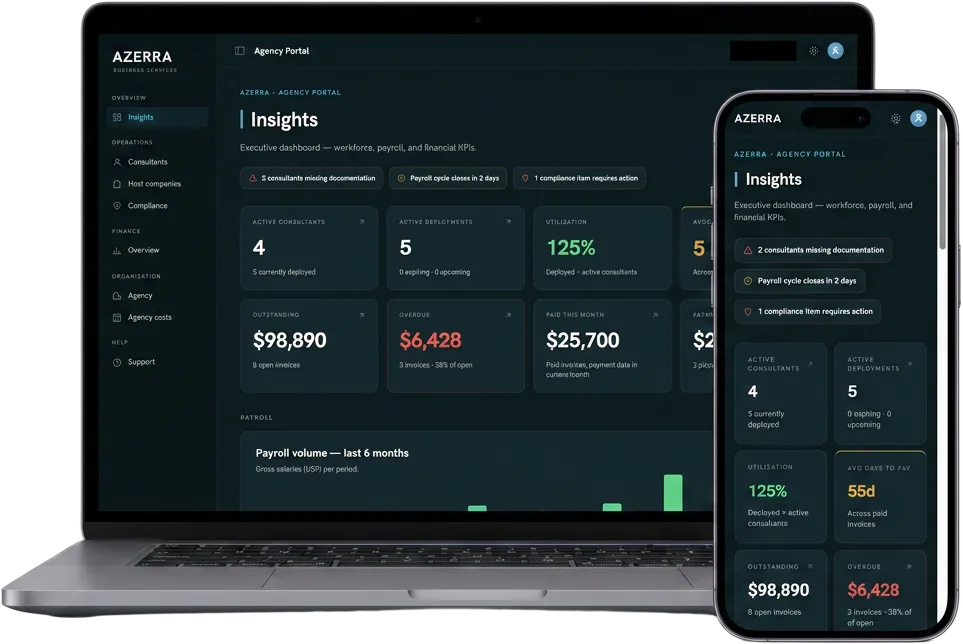
AZERRA Connect
Follow the process through AZERRA Connect
Know what is complete, pending, or required.
A deployment should not feel like a black box.
AZERRA Connect gives authorized users access to relevant deployment records and status information.
Depending on the engagement, clients may be able to view:
- Employee onboarding
- Documents received
- Documents outstanding
- Employment agreements
- Immigration stages
- Permit and residency information
- Payroll records
- Invoices
- Assignment details
- Expiry dates
- Required actions
This gives project, HR, finance, and mobility teams a shared operational view without reconstructing the status from separate emails and spreadsheets.
Deployment roadmap resources
Immigration Document Checklist
See the documents commonly required for entry, residency, work authorization, and accompanying family members.
Employment and Compliance Guide
Understand the EOR structure, local employment agreements, responsibility allocation, and assignment lifecycle.
Payroll and Tax Guide
Learn how net-to-gross payroll, rotation schedules, tax, exchange rates, banking fees, and cost simulations work.
Family Relocation Guide
Understand housing, schools, dependant immigration, banking, arrival, and family settlement.
Suriname Deployment Guide
Read the complete guide to employing and supporting international workers in Suriname.
Ready to map your deployment?
Book a 20-30 minute advisory call with AZERRA.
We will review your headcount, nationalities, roles, rotations, intended start dates, compensation structure, family requirements, and support scope.
From there, we can identify the correct employment model, immigration route, cost structure, document requirements, and practical next steps.